inspiration, leadership, life lessons, mindfulness

I Dare You Tuesday


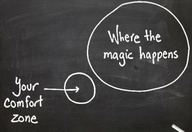
Ok my friends, it’s time..today is the perfect day to consider what you would do if you weren’t so darn comfortable in your comfort zone.  I know there are some who challenge us to do one thing each day that makes us uncomfortable, to test the shackles in which we have secured ourselves.  I don’t know about you, but that makes me too anxious and overwhelmed,  the thought exposes my insecurity before I even begin.  So how about this – one new effort per week.  What are you going to do to touch where the magic happens?  The allure alone is an incentive;  is it strong enough to entice you to re-evaluate your choices?  Can you feel the exhilaration and fear that accompanies the first steps in a new direction?  Can you imagine how freeing it will be to just try one thing you’ve never done before?  Whether it is at work – with your employees and colleagues, or the care and attention you give yourself,  or the upending of a routine that has gotten tired – it can be anything that moves you closer to the magic of being in your life.  So tell me, what are you going to do?  I can’t wait to hear…

discretion, leadership, life lessons, management, mindfulness, training

Was It Right Or Wrong? Yes.

“In looking for people to hire, you look for three qualities – integrity, intelligence and energy.  And if they don’t have the first, the other two will kill you” — Warren Buffet

When I was at the firm, I facilitated a program about Situational Ethics.   Various hypotheticals were offered up for discussion – all work-related obviously, but ranging in subject from employer/employee dynamics to issues of client confidentiality.  The realities of workplace demographics were a primary driver for the creation of the program.  The firm had grown exponentially and people were not staying ‘from cradle to grave’,  challenging the cultivation of loyalty and a deep understanding of the commitment to work reflective of unparalleled integrity.  Certainly dedication and tenure along with personal and professional accountability are very strong motivators for people to do the right thing.   We all know when something doesn’t pass our ‘sniff test’ – but what we then choose to do is another issue entirely.

As people become more and more anonymous within companies as a result of technology, higher turnover and generational perceptions, the risk of fraudulent and/or dishonest behavior escalates.  Even with the most sophisticated processes in place, someone will still knowingly enter their time incorrectly, submit inappropriate expenses for reimbursement,  falsely assert that something did or didn’t get done, etc.. Are any of these ‘wrong’ enough?  Where does the responsibility rest?  Is it the individual’s responsibility to maintain his/her integrity in the face of an ‘every-man-for-himself’ workplace?  Is it the employer’s responsibility to underscore its absolute conviction to such a principle?  And if the answer involves the latter, how does one respond when some misdeeds are overlooked?

I write this with no answers.  On the one hand, I believe in the very basics of right and wrong – do the right thing by the people who work with and for you, don’t take what isn’t yours, tell the truth…On the other hand, have there been times when what I thought was the right thing, wasn’t?  Have I always told the truth to my boss?  Yes, there have been times when my actions probably were ill-considered, and knowing some of the bosses I have had in my career, there have certainly been occasions where his/her lack of receptivity, defensiveness or demeanor led me to couch my words or obfuscate them to the point of being completely opaque.  Does it matter if my intentions were good even if the outcome reflected otherwise?

I suppose that is why the elements of a given situation often drive the answer to these questions.  Rights and wrongs can often be variants of black and white, not absolute in any way.  Certainly, I still hold that if one’s actions are guided by a belief that first and foremost  we are here to offer the best of who we are to others, we’re on the right track.  But beyond that, I’m not sure there are too many other absolutes.  What do you think?


“If everyone were clothed in integrity, if every heart were just, frank, kindly, the other virtues would be well nigh useless” — Moliere


leadership, life lessons, management, mindfulness, motivation, training, work life

No Buts About It

When I was a newly minted teacher (please bear in mind, I started working when I was three), I was told that the word ‘don’t’ was anathema, verboten, that-which-is-never-said when disciplining young children.  So, instead of  saying “Jennifer, don’t run in the hall”, the correct guidance was “Jennifer – walk”.  “No shouting” became “Use your inside voice”.   On the one hand, I thought this was really trite and yet theoretically it seemed reasonable.   It was harder to change my speech pattern than I thought;  frequently used vocabulary become habitual.  Ultimately, this one lesson has remained in my head throughout my career.  In your day-to-day conversations,  do you think of how you’re framing your comments?  Have you listened to yourself lately?  Do your words inspire or deflate?

There are two incredibly demoralizing and powerful words that are regularly invoked in conversations – “no” and “but“.  I realize that there are times when both are necessary.  That said, there are more occasions than not when their utilization causes a far more adverse impact than we may intend.  How many people do you know begin their sentences with the word “no’?  If you listen, you will find that many do.  Even when agreeing with someone,  a response often begins with a negative.  A recent example of a conversation with my son:

“Hi sweetie pie, how are you?”

“No, I’m good.”

“Are you going to go see ________?”

“No, yeah in a little while.”

Though you could toss this up to idiosyncratic conversation, I can regale you with more examples in the workplace, at dinner with friends, in any number of environments than you would care to read.  We are in the habit of saying ‘no’ first.  When providing someone with feedback, we invoke the word ‘but’ as we try to give someone objective, constructive observations of his/her performance.  “The quality of your presentations are excellent, but you need to increase your productivity”.  As soon as the word ‘but’ is introduced into the sentence, the positive sentiment is diminished – if not completely forgotten.  And yet we do this all the time – at work, home, wherever…In my presentations I ask people to insert the word ‘and‘ in place of ‘but’ – the perception of the sentence changes remarkably.  At the end of the day there is no one without strengths and weaknesses.  As a developer of people’s’ abilities, it is your responsibility to find the most effective way to encourage growth and improvement.  Leave out the ‘but’ – try it.  It’s harder than it seems.

I further challenge you to count the times you say the word ‘no’ in a day.  Chances are you often don’t even think about or mean it, you’ve just incorporated into your pattern.  It takes little thought to recognize the impact of our words.  Arguably they are more important than ever before given that we live in a time when we speak with each other less and less, and assume people’s’ intents from 145 characters.

Conversations at Vermillion
Conversations at Vermillion (Photo credit: JeanineAnderson)

But don’t take my word for it – no, you really should find out for yourself.

friendship, inspiration, leadership, life lessons, management, mindfulness, motivation, training, work life

The Feeling Is Mutual

It’s 1:45 in the morning and I’m sitting here at the Knights’ Round Table, with a cup of coffee and a heavy, unbreakable silence that pervades the house.  Even the Knights have dispensed with their evening wanderings — ensuring that the kingdom is secure before retiring to their abodes (e.g., my bed).  The last training session for this program ended today…um, yesterday, and my mind is racing with post-mortem thoughts that needed a place to go.

(In case you’re wondering I don’t look nearly as refreshed as this woman does)

I have told you about the level of engagement of the participants, the richness of our dialogue and the development of professional bonds which will likely continue and thrive.   On this, our last ‘official’ time together, the group surprised me (which is rare – I don’t ‘surprise’ easily).  I returned to the conference room after making a phonecall, and there they were standing together by the door, snapping their fingers and singing “we love you” (the melody was unclear but it definitely had a beat because everyone was dancing.  So…I danced too..)  To make this brief, we were laughing and I was fumbling around with my sense of wonder when they gifted me with a memory to last a lifetime.  They told me they thought I was terrific and wanted to thank me for our sessions.  A gift of personalized stationery and a  custom made t-shirt with a motto of mine (that’s a secret which will be revealed in another post).  What was just as astonishing were the personal messages each person wrote on a card to me.  Expressions of appreciation for the program and hopes for continued dialogue, one person called meeting me a ‘blessing’, every one commenting upon the impact the course had on them and their delight with the content and me as the facilitator.  I don’t want to overstate the incredible feeling this evoked in me, nor do I want to make this post about me.  It’s about them

You know how much energy I received from their collective and individual enthusiasm.  You can imagine the loyalty that I feel towards such a devoted group, and how much I want for them to continue striving to be the best managers in their offices.  And they will.  At one point, J asked me, “so what motivates you”?  And I realized that for me there is nothing more gratifying than positive connections.  I facilitated a program – their interest in the content fed my enthusiasm, my soul and my sense of purpose.  We can impact many, we can impact one.  And if fortune is kind, and those moments become integrated into a person’s way of doing business, his/her approach to others and their lives in general, then they have hit my motivational sweet spot.  These participants nailed it every Thursday – and yesterday gave me more than I feel I can ever return (but will continue to try).

I am sorry for their senior managers who don’t recognize the quality in their ranks, the innovative thoughts and strategies that are simmering on the back burners of ‘those in the trenches’.  If you don’t seek feedback from your direct reports about what they are seeing, what alternative approaches they are considering and whatever out-of-the-box ideas that are constantly germinating in the minds of those seeking to enhance and engage the workplace, you are missing the greatest resources available to you.  The workplace is morphing before our eyes – our challenge is to respond with forethought and consideration.  It serves no productive purpose to wait until the tidal wave of change washes over our offices and we are left shell-shocked and reacting to change far too late to do more than clean up the mess.  We have some tough decisions to make over the next few years – our staffing paradigms will change, virtual management is no longer a thirty minute sit-com called “Max Headroom” – it’s a reality.  Technology is allowing clients to demand 24/7 availability while it is also removing our gift of dialogue and the nuance of the written word.  The values upon which most firms were founded no longer hold up under scrutiny (hello Dewey LeBoeuf).  Who will respond to these waves of change?  People like those who attended this workshop.  These are the people who will do the hard prep if you ask them, ask provocative questions before they become moot and who truly want to create the best professional environment possible.  I send them love and thanks – they taught me so much and in exchange I feel like I really gave so little.  I only offered my time, some insight that experience and training have afforded me, and a genuine focus on their development.  It was my responsibility and my privilege.  When they return to their offices, I hope someone in a senior position does his/her job – listen to what these people have to say – and consider acting on their ideas.  I will miss them next Thursday, but I will remember them forever.

leadership, management, motivation, training, work life

Second – We All Work For Somebody

When Eric Clapton did a cover of the song “Serve Somebody”, it was clear he was talking spiritually.  It’s one of my favorite songs and I fold into the music and the words like Gumby (note to those reading this who are too young to remember Gumby, Eddie Murphy skits where he is pretending to

be Gumby or the cartoon show based on the character – I’m sorry).

This is Gumby..


…he has nothing to do with this post..

In the context of this commentary, when I reference ‘serving somebody’, I’m talking about work.  After all, we all report to someone – a boss, a management board, committee, owners, clients, etc.  I have written about my perspective on management’s responsibilities; I have not been as prolific about the corollary – the responsibility of direct reports.

There is an interesting article in “Inc” magazine titled “8 Things Great Bosses Demand From Their Employees” By Geoffrey James.  In brief, James maintains that the following represent the most important expectations an employer has of his/her direct reports:

“1.  Be true to your word

2.  No surprises, ever

3.  Be prepared on the details

4.  Take your job seriously

5.  Have your boss’ back

6.  Provide solutions, not complaints

7.  Communicate in plain language

8.  Know your real job”

Recognizing that direct reports could say the same things about their bosses, my view is that the list for them is longer and a bit different.  That said, if both groups could successfully meet these eight expectations, I think most organizations would be way ahead of the game.  Given that everyone answers to someone – what do you think of this list?  Does it seem reasonable?  Doable?  Do you take these expectations on, or are you waiting for your boss to do so (in which case, I would strongly recommend that you go ahead and do the right thing – it will serve you better in the long run).  What’s missing?  Regardless of where you are within your business community, I’d love to hear from you.  If we can make our work environment better, why not try to do so!

Gumby at the DIA
Gumby at the DIA (Photo credit: Jordawesome)
leadership, life lessons, management, mindfulness, motivation, training, work life

Shoop Shoop Shoop – Are You With Me?

Driving home from yesterday’s 4th training session, the “Shoop Shoop Song” from “Waiting To Exhale” was playing in my head.  In many ways it’s also the perfect Friday song, and given some of the posts I’ve read this week, it’s appropriate for the end of what appeared to be a tough week.  Seems like a lot of us spent much of the week just waiting to let it go…

“And sometimes you’ll laugh, and sometimes you’ll cry

Life never tells us the whens and whys

But when you’ve got friends to wish you well

You’ll find your point when you exhale…”

You can add the ‘shoop shoops’ yourself – there are a lot of them.

Yesterday, I facilitated the last training session with the remarkable group of people of whom I’ve written before.  Next week, a colleague will join me for the last part of the program.  So in some ways, I had to say good-bye to a dynamic which has fueled, inspired and challenged me once a week for the month.  We’ll have a great time next week, and the team united as we know will morph naturally by the presence of a new person.  The thought of the upcoming farewells has my stomach more than just a little knotted.

Our topic yesterday was Performance Management – with emphasis placed on the fluidity of the process – the need for it to be a constant loop of communication, not the culmination of twelve silent months with no conversation about a person’s performance.  We addressed some of the real issues managers grapple with – the star employees who don’t receive enough feedback because ‘they know’ they’re terrific and other people require more attention; the poor performers who supervisors avoid because ultimately the anticipated hostility/tears/aggressive/defensive reaction (pick your adjective) is just too painful to endure.  The challenge of actively listening when studies show that adults really attend for about five minutes within a twenty-minute conversation.  How commentary is far more critical than a ‘score’ and how to move a firm and its people away from the numbers and in to substantive feedback.  Including the employee in establishing goals, and how to build those goals effectively.  We went straight through, with a quick break to bring in some lunch, and just kept going until we could go no longer.  They crushed it – figuratively and in a good way.  The examples provided, support given to those with a tough situation to handle, enthusiasm and trust in each other – all were so impressive.  They inspired me more than I can adequately describe.  Do you sense a ‘but’ in all of this?  Good – I’m so glad you picked that up.

When our sessions end, they go back to work.  At best their supervisors ask them if they’re enjoying the program, if they’re getting anything out of  it,etc..  That’s it – the curiousity and interest in the manager and his/her development stops there.   They are coming away from these meetings with new ideas, a renewed sense of purpose, some thoughts about bettering themselves and their department.  There wasn’t one person who affirmed that his/her boss would be interested in pursuing anything other than things as they are.  The most frustrating aspect of this reality, is that I just know what will happen to their enthusiasm, focus and intention.  Worse still, they do too.  I’m committed to being available to them should they need me,  but let’s be real –  as time passes everyone gets caught up in the rhythm of their days, and without someone encouraging movement and effort from their supervisors, there is an inevitable return to the norm.

If you are a director or C-level officer, are you really giving your direct reports the room, support and mentorship they need?  Are you working with them to formulate opportunities to practice that which they’ve learned once training programs end?  What’s your stake in their growth and how do you show that commitment?  I’m just wondering, because from where I stand this seems to be the most important part of your responsibilities and the easiest one for you to minimize or disregard.  I’m just sayin’…I know there are some exceptional senior executives who read this blog – it would be great to know what you do with and for those managers you send for professional development training once they’ve completed the program or class?

I will miss these Thursdays, yet that doesn’t diminish the value they have held for me.  I have met outstanding people, forged a bond that is predicated upon a shared desire to do the right thing for those they supervise and for their firms.  I wish them all the success, growth and all the happiness their hearts can hold.

So it’s Friday morning, and the sun is slowly rising.  The week ends with some exhausted by the emotional toll that the last few days have exacted; others are thrilled that the week has gone so well.  For everyone,  I hope the time arrives sometime today when you get to exhale.  Happy weekend all.

leadership, life lessons, management, motivation, training, work life

Schadenfreude? In This Economy?

Funny how I think I’m going to write about one thing, and end up going in another direction entirely.  Upon further reflection, if you knew how I drive this is probably not so surprising at all.  I adamantly believe that whatever direction I’m heading is north, think I’m going over underpasses and have been known to turn a map upside down when navigating a return trip from wherever.  I get lost a lot, though I’m perfectly comfortable asking for directions.  But, I digress….

A very dear friend of mine quit her job on Friday.  She enjoys a successful career, working at the senior levels of management.  On Friday she reached a limit that no one should have to push, so she packed up her office, provided her resignation and walked out the door.  I’m not going to spend too much time extolling my friend’s impressive qualifications and talents – her success is evident in the tenure, promotions and stellar reputation she has earned.  Besides, this isn’t a paean to her (though she deserves one), this is a cautionary tale.

Why’d she resign?  Because her boss – a V.P. who should have known better – was a bully.  This woman focused her energies on making other people feel really lousy.  For months she badgered, verbally lashed and demeaned her direct report – a senior manager.  Do I believe the karma truck is going to roll up this person’s driveway?  Oh yeah..I do.  It’s already in ‘drive’, for she can’t fill the vacancies she has, and now has one more opening in a critical space.  My hunch is that ultimately she will be ‘outed’ and invited to leave.  One has to have pretty strong ego needs to diminish the people you most need to build up – the ones who have your back and are carrying a  heavy workload on your behalf.  Greater is the pity that she will undoubtedly be packaged out with an impressive amount of money.

I don’t need to remind any of you about the potential legal implications of such behavior.  That’s a discussion for another day.  Apparently the V.P. enjoys this reputation she has earned and savours the unhappiness and unease that she engenders in others.  The sad irony is that she was vetted after joining the organization and people began wondering why such a hire was made.  What makes this even worse in my mind is that in the male-dominated environment where they both worked, this woman found her key to the executive washroom by belittling the efforts of another woman.  The examples of the daily exchanges, meetings and unrelenting personal criticisms could fill a very long tome describing various types of professional hell.

At the end of the day, my friend is fortunate.  She isn’t shackled by golden handcuffs and isn’t beholden to anyone.  She is taking some well-deserved time to restore, and ultimately wherever she goes, she’ll hit it out of the park.  This organization, however?  It’s too large to fold because of one really bad apple in its highest ranks (or two or three), and it would be naive to think so.  But the cost of irresponsible vetting, questionable accountability at the top and a weak professional value system will be high.  Whether it is realized in turnover, legal claims or diminished productivity – the impact of self-centered oversight is profound, expensive and long-lasting.  It’s too bad there isn’t a Hippocratic oath for supervisors at every level – “first, do no harm”.  It’s too bad that in some organizations, a person can thrive while fomenting unhappiness among those for whom she’s responsible, and climb the ladder in her Laboutins by stepping on toes and heads instead of the proper rungs.


anxiety, inspiration, leadership, management, work life

The ‘ShootingMyMouthOff’ & The ‘ShouldaCoulda’ Flu

I hope the title evokes thoughts of  Johnny Rivers or Aerosmith – that’s what was playing in my head this morning.

How many times have you said to yourself, “I shoulda said”, “I coulda said” or “I woulda said something, but….”.  It’s a common malady, the ‘should-woulda-coulda’ flu.  I’ve been infected more times than I can count – at work certainly, and in other areas of my life as well.  Its onset is so rapid you don’t even know you’ve got it until you try to open your mouth to counter a comment or action with which you take issue, and then rationalize why you shouldn’t say a word.

There is of course a corollary to this bug, which manifests itself with almost uncontrolled verbal expressions which are provided with or without invitation.  It’s also common in the workplace – the ‘shooting-my-mouth-off’ syndrome.  Again, there are no early symptoms, other than the overwhelming urge to say whatever is in your head without filter or forethought.

Although neither is recognized by the AMA, the effects of both can be lingering and negatively impact your relationships and your career.  The good news?  Both are controllable – and with a little exercise and a change in your emotional diet, you should feel pretty good about the prognosis.

There are times when we all feel the need or desire to speak truth to power – or at least what we perceive the truth to be.  You see an issue or problem that is being overlooked, diminished or ignored by those above you in the management hourglass.  In the first instance, you say nothing at all – you don’t want to be seen as negative, maybe you anticipate an angry or dismissive response or feel resigned that your perspective isn’t going to affect the outcome anyway.  In the latter, you tell your supervisor everything you see and hear, rationalizing that you want to keep your boss ‘in the know’,  assigning an ‘urgent’ rating to each conversation and feeling strongly that it’s your job to put it out there, and your supervisor’s job to remedy the situation.

Neither is absolutely right, neither can feel all that good and neither is reflective of your best professional aspect.  I believe that timing is everything – and though certainly I don’t always get it right by a long shot – I have learned to wait until I feel the odds are best for my audience to be attentive to what I’m saying.  (In the interest of full disclosure, I am undoubtedly also driven by my disdain for confrontation and will do what I can to minimize the likelihood of a conversation becoming hostile.)  No one controls what you say and how you say it other than you.  For those who feel your comments are futile – consider that you are in a position where there is an expectation for to you provide your insights, recommendations and perspective.  Although it may easier for you to ‘go along to get along’, if you can improve a situation you have a responsibility to do so.  And if any of you out there have a tendency to speak before thinking about the content and manner of your delivery – the expectations are the same for you too.  Impulsive, ill-conceived comments will sabotage your success with equal speed and force.

Take ten – ten minutes to stop and think about the problem that you see.  Evaluate its urgency, where your audience is at the moment and how to best disseminate the information.  Presuming the situation is not an emergency, think about the possible solutions you can recommend.  ‘Initiative’ is more than bringing an issue to someone’s attention – it also references your ability to provide some potential resolutions as well.  You need to take time to consider problem-solving alternatives before elevating the concern.  And for those who hesitate to say anything – you need some time too – to accept that this is part of your responsibilities and determine the approach that will be most comfortable to you.  Doing nothing is not an option, so don’t even go there.  The goal of the conversation is the same regardless of which ailment you may have – to identify a concern, assess its accuracy and provide objective recommendations for cure.

I realize that when you’re under the weather with symptoms of  either virus, such counsel may be unwelcome.  Yet the bottom line is – real business concerns need to be brought forward – and your professional stock will rise if you do so in the right way and at the right time.  Walk around the block, take some Vitamin C and if you need to,  practice your comments before you make them.  I speak with many managers all the time who feel there is no point in bringing issues out in the open.  I feel their sense of resignation and I ache at their feelings of futility.  I have to say that there are some conditions far worse than the two I’ve mentioned today.  Giving up and giving in to indifference is a far more dangerous and intransigent bug – one which spreads with impressive virulence.  Your views do matter, your recommendations are important and valuable – just make sure your outlook is healthy before you speak.

friendship, inspiration, leadership, management, training

High Hopes – Session Three

Yes, I’m embarrassed to admit that this is one of the songs that repeated in my head as I drove home from my third training session yesterday….”everyone knows an ant can’t/move a rubber tree plant/but he’s got high hopes/he’s got high hopes/he’s got high-apple-pie-in-the-sky hope…”

What can I say, I can be such a geek that I even I shake my head in disbelief.

Yesterday we met for our third training session – using Bruce Tulgan’s “It’s Ok To Be The Boss” as our framework.  I like Tulgan; I love the participants in the program.  I’m already dreading our last day – I have received more from this arbitrary group of people than I could ever provide them in return by facilitating these discussions.  I need to share with you just some of what I have learned – or re-discovered while on this brief journey with this engaged group of people:

–  Trust first, second, third, fourth…They demanded trust – from each other and from me at the outset of our program.  Our ground rules began and ended with that premise – what happened in the program, stayed in the program.  We would share openly, without filters with the understanding that I wanted to be challenged and I would reciprocate.  What continues to inspire and delight is the amount of mutual respect that certainly has trust as its predicate, but is furthered by the efforts that are made to be of help to each other.  Yesterday we spoke at length about some of the people – supervisors and supervisees – that present the inevitable frustrations and challenges that are faced on a daily basis.  The energy expended in truly listening to the speaker and attempting to respond with constructive, alternative approaches was staggering.  And tiring – we were all pretty fried when the day ended while still looking forward to next Thursday for another exercise in enthusiastic exhaustion.

– A network of people who do what you do, experience similar difficulties, share parallel objectives can provide more than just an opportunity to vent (which has its benefits, no doubt).  Your network can provide relevant suggestions,  commiseration, a dose of humor, perspective and  a sounding board for testing new ideas or strategies before bringing them forward to the powers-that-be.  And people in your network will hold you accountable to participate in kind.

– Shame on the C-level or director-level people who encouraged the participants’ attendance and never really intended to help them move forward with the very real challenges that these managers are facing all the time.  Since most of the people who read this blog never worked with me, I can risk being redundant  – hopefully without boring you.  Law firms face some difficulties which we haven’t addressed for years – an overabundance of local and global administrative resources who aren’t busy, aren’t being re-tooled and are largely being ignored because it’s the easiest option.  Many firms are not as busy as they once were and work is not being distributed evenly – some partners handle the work typically completed by senior associates, associates grab for paralegal work, paralegals take on administrivia and ennui creeps into the environment like some sort of ivy from “Little Shop Of Horrors”.  Expectations and a sense of entitlement permeate the air, along with the hum of people listening to their iPods while shopping on Amazon or Groupon.  We realize this has happened; we haven’t made the hard decisions that would allow people to move forward.

We have been working during these training sessions – and these managers can provide some terrific thoughts about shaking off this pervasive inertia – an engaged leader would listen to them.  These are smart, committed, devoted people who want to get their departments operating at the highest professional levels.  Listen to them – do more than just asking if s/he liked the course.

– We are a team.  We are proof of the distinction between a group of people who happen to be serendipitously thrown together by time and circumstance.  We call each other on the play we did (or didn’t) effect, support each other as we strive to fulfill both individual and group objectives and decisions are transparent.  The day is long, we take short breaks, bring our lunch in and get back in the game because we are all in it.  As one person lags during the 2:00 PM ‘I need a nap’ moment, another encourages him/her out of it with a cup of coffee (or the recommendation to get up and move around).  The rhythm of the day changes all the time – it’s my job to feel the ebb and flow and get us through in the most effective way possible.  That also means I often lead from behind – in other words, I let someone else take control of the conversation. It gives others the chance to control the direction of our dialogue, gives voice to specific concerns and provides a ‘safe’ place for people to practice their leadership skills.

– At the end of each session, each person writes about their ‘take-away’ from the day.  I take away a renewed awe at the tremendous results effected by a team of people from different generations with different cultural and ethnic histories  (so much more than that which can happen with a cookie cutter group of people).  I take away laughter and questions still to be answered and the humbling experience of watching someone have an “aha” moment.  I take away anticipation for next week and tremendous appreciation for having had the opportunity to spend the day with people who really want to exceed their own expectations.  I look forward, as always with “High Hopes”.  Happy weekend everybody.

leadership, management, motivation, training, work life

So You Want To Rock The Management World?

Oh boy, are you going to be mad at me when you’re done reading this.  Reader be kind, and understand that sometimes the best advice may not make your top ten choice for best lyrics and the rhythm may be hard to dance to, but it is destined nonetheless to replay in your head ceaselessly (kinda like “Mandy” by Barry Manilow – you want it to leave, and it stays and stays and stays…).  I hope today, I am your “Mandy”….

I began leading a five part training program yesterday, working with new managers and supervisors on the fundamentals of their jobs now that they are responsible for people other than themselves.  We had an energetic and productive day; the conversation was lively, thoughts were unfiltered because the environment was conducive to the trust and acceptance that comes from working on a level playing field.  We’re all looking forward to next Thursday.  Do you hear a ‘but’ in my written voice?  Please tell me you do, for there is one.

Here it is – if everything went so well, why do I feel ambivalent about the results?  Why are these engaging people attending this program? (“Oh, Mandy….”).  I know the obvious answers – the syllabus looked intriguing, they need/want training that will enhance and/or introduce new skills to their managerial toolkit, their supervisors want to feel like they are according them with professional development opportunities, etc  (“You came and you gave without taking…Oh, Mandy”).  I get all that.  Each person left with a detailed commitment to doing one thing differently before next week.  And their takeaways were good.  Talk about ‘koombaya’ moments – it doesn’t get much better for someone like me.

Yet with all this good stuff, there is a reality that can’t be ignored.  The supervisors of these people – whether at the C-level, director, administrator – regardless – send people to training with some implicit expectation that they will emerge more seasoned, greatly enhanced and/or permanently, positively changed by the experience.  The supervisor gaveth the training, and the new supervisor is now minted.  Well, I’m going to shoot myself in the foot here – give me a moment, while I consider the value of self-harming…hmmm..

Ok, I’m going to do it anyway.  Sending people to training – even the most outstanding training on the market – doesn’t mean a damn thing if you are not planning to hold people accountable for their post-training results.  It is critical that supervisors expect that along with attendance comes a post-seminar conversation that addresses any ‘aha’ moments the individual may have had, what revised goals or objectives might be derived as a result of the training and then (drumroll, please we’re getting to the bridge of “Mandy here” – oh, and can I have a shield to protect me from your pelting tomatoes)  – you have to hold them accountable.  There is no training in the world that is going to catapult a new supervisor into the sphere of rock stardom.  No course is offered from which managers will emerge forever changed – unless someone is following up with them.  People may feel short-term inspiration, pumped up about the interesting conversations and ideas, hopeful that they can now deal with a challenging employee in a new way.  But you know as well as I, that the ROI is not measured in the first days post-training (“But I sent you away, oh Mandy….”).  It is measured in the engagement of employees within the department, the quality of the intra-and-inter-department communication, the effectiveness and facility with which newly trained managers pay-it-forward.  As I have said before (sigh…”And I need you today…”) – people aren’t ‘managed’; people are ‘developed’.  That takes time – your time.  How accountable do you hold yourself for ‘developing’ your people?  Tougher question – how accountable do you hold yourself for getting involved in the professional progression of your people post-training?  Besides asking how the program was, what do you do to ensure that their ‘takeaways’ become organic elements of their management style?  How often have I heard a participant say, “My manager would never let me do that”, “How can I get my boss to see that this is really a good idea?”, “I have the title, but not the authority to really impact the team”….

So there’s my big ‘but’ (please note the spelling of the word) – If you’re going to invest in your people financially, recognize that it doesn’t get you off the hook.  It puts you directly on it – as it should.  You are now going to have to invest your time, your flexibility, your willingness to walk the walk and talk the talk if you want to truly maximize the impact of  training and development programs.  It’s so not about the money – it is so about you.  After all…”…[you] write the songs that make the whole world sing…..”  Sorry, I couldn’t resist.  

humor, leadership, life lessons, management, motivation, work life

B-B-B-Bad To The Bone

There’s something to be said for being bad – and there are many who have become quite successful for their complete lack of ability (presuming of course that one is represented by some tremendous PR people).  The examples come quickly to mind – any Kardashian, reality tv (I’m sorry, I know many of you love it – I just think watching people reduced to tears because of their appearance, love life, swapped spouse or horrific fashion sense is just not, well…good), shock jocks, Paris Hilton, etc.. I get it – there’s a lot to be gained by being talentless – fame, money, one’s own personal posse, Louis Vuitton doggie carriers, an interview with Dr. Phil…

So I’m here to help in the only way I can – I can provide you with some very clear guidance on being a lousy, really bad boss (without violating any federal or state labor laws).  Please, please – no need to thank me.  If this is what you’ve been searching for all along, I share your surprise at the dearth of information than can help you be a terrible supervisor.  Perhaps some of this has been obvious to you all along, yet with all the emphasis on self-improvement, professional development, challenging one’s self to embrace excellence, I can see how the simple steps one needs to take to reach farther down can get lost in all of this positive, ‘you-can-do-it’ energy.  Sit back and relax dear friends – let me offer some basic actions that you can apply today in your quest to hit new lows in lousy leadership.  I promise – you too can make your company’s “Worst Supervisors” list and begin your descent into infamy.

– Don’t give a hoot about the people for whom you have responsibility.  This can be done in any number of ways – ratchet back your feedback to the barely relevant;  assure you’ll get back to someone asap and don’t do it; provide conflicting information about a project’s requirements.

– Say ‘no’ as often as possible.  Leave any affirmative responses for times when you are under untenable duress and see no other alternatives.

– Gossip as much as you can – ideally about people within your department.  If you can manage to engage in these conversations with others on your team, all the better.

– Complain – a lot.  Don’t feel that it is your responsibility to make the workplace a collegial, energized, collaborative environment.  Put that on someone else and then find fault in whatever efforts s/he makes.

– Own as little of your job as possible, and demand that your people take full ownership of theirs.

– Play favorites if you can, though I caution you that you may begin a slippery slide down the path of discriminatory practice.  I’m not looking to help you become a defendant here.

– Take everything personally and react as defensively as possible.  After all, isn’t it all about you?

– Keep your people in tall, separate silos – the less they know what is going on around them, the better.

– Try to understand as little as possible about what your people are doing – there’s nothing more demoralizing than having a boss who has no clue what the hell you do everyday.

– Maintain an opaque quality to your communications.  God knows what could happen if you sought the maximum amount of transparency – people may get ideas, offer their thoughts about a given objective, feel part of a bigger whole, etc.  Ix-nay on the communication, ok?

– Don’t commit to doing what you assure people you’re going to do.

– Keep your door closed, don’t walk around and whatever you do – try not to smile – even to those who may acknowledge you warmly.  The good news is that if you keep doing these things, you will quickly not have to concern yourself with anyone greeting you at all.

– And finally, I would tell people that all that matters is results, though I wouldn’t disclose what those measures are.

See?  I told you this wouldn’t be tough.  I am confident that if you follow these simple guidelines, you too can be really bad at what you do.  Of course, if you are one of those people who responds to reverse psychology, I apologize in advance.  You may end up responding in the exact opposite manner than that which is outlined above – and we all know where that gets you.  You’ll become one of those people who is driven by the challenge of making a positive difference in your day and the days of the people with whom you work – ugh!.

humor, leadership, management, motivation, work life

The Wizard And I

“The Wizard Of Oz” – not to be confused with The Wizard Of Menlo Park of course.  After all, one was a movie musical with a series of limited but determine characters in not-so-subtle costuming, the other referenced Thomas Edison, thought by many to be one of the greatest Americans of all time.  Given that scores and scores of books have been written about Edison, I think it is my duty to address the brilliant management and leadership lessons that one can learn from following a yellow brick road.

1 – There’s something to be said for being ‘the man behind the curtain’.  The strongest leaders do not need to advertise their power, rather they advertise the talents of those around them.

2 – Mentors typically don’t make themselves known by descending from the sky in a transparent globe, holding a wand and wearing a crown.  But they’re out there.  Mentors can be people within your organization who have successfully navigated its twisty, winding paths, know where the flying monkeys lurk, who have the magnetism and talent that people gravitate towards and/or have the technical expertise from which you can learn.  They also may not be looking for you, so it would behoove you to seek them out.  And parenthetically, it’s probably better if they don’t sing soprano with an insufferable vibrato.


3 – Some days you’re the house, other days the house falls on you.  Either way, neither state is forever (unless you happen to be a wicked witch – and if you are, there’s probably better reading for you out there).

4 – The best teams are comprised of people with markedly different talents.  It’s best not to duplicate areas of expertise, rather seek those who’s abilities will be complementary.  Chances of effective project completion are highly increased, everyone emerges stronger and more well-versed than when they began and you can maintain a shared vision of the goal without introducing individual competitiveness.

5 – It’s good to carry a bottle of water around with you at all times.  At the least, you’ll stay hydrated.

6 – The easiest way to achieve insurrection is encouraging people to follow you by dicta rather than by choice.  Rest assured that your people will leave your side at the earliest opportunity if their contributions aren’t valued, their input ignored and their chances for professional exploration limited to a narrow, controlled orbit.

7 – Help your  people realize their professional goals.  Not only is it your job, it will enhance the talent stream, engender loyalty and infuse the work place with energy.

8 – Courage means different things to different people, but supporting your people as they break out of their comfort zones is an enriching experience for you and a thrilling new beginning for them.

9 – Show your heart – it only makes you appear stronger, more authentic and relatable.  It will not diminish your authority at all.

10 – Work and home are inter-connected.  They don’t exist in separate silos.  It is impossible to separate the two when there are issues or concerns involving one or the other.  It is far better to recognize this and determine the best way to reconcile the two rather than having them at war within you.

And finally, if you really feel you need to, invest in a pair of ruby slippers.  They aren’t going to help you get anywhere, but they should appreciate greatly over time.